
Abstract
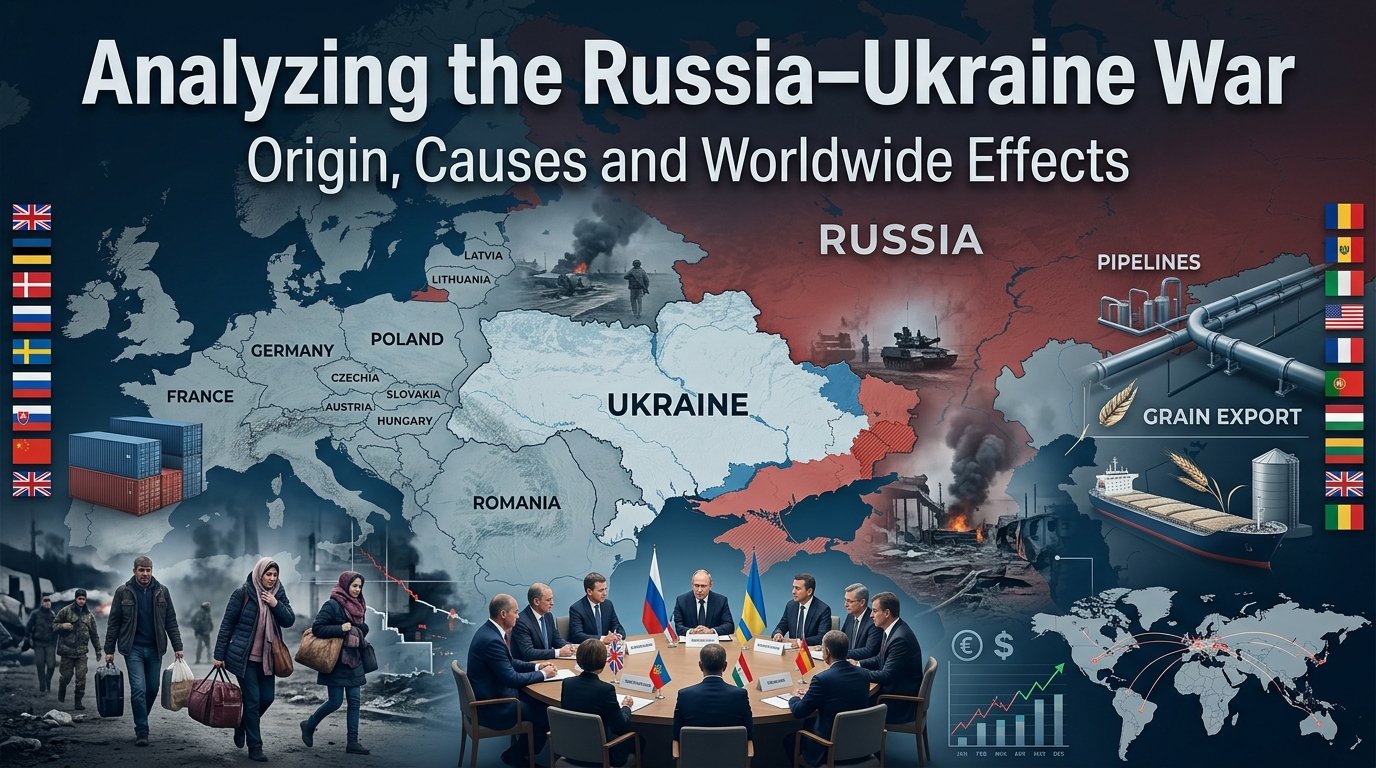
The Russian invasion of Ukraine in 2022 is the largest European war since 1945, driven by post-Soviet geopolitics, NATO expansion, and national identities. It has caused unprecedented humanitarian and economic losses, disrupted energy and food markets, shifted NATO and EU security policies, and increased Russia-West tension, while diplomatic peace efforts have failed.
Introduction
Russia–Ukraine war is one of the most prominent international wars in the twenty first century. It has changed the course of international politics, influenced international security, impacted the economies and led to a huge humanitarian crisis. The war officially started in February 2022 with Russia’s full-scale military invasion of Ukraine, although there is much more to the conflict in terms of its history, politics and regional power politics. The war represents a conflict between Russia and the West, a struggle over ethnic identity, nationhood and territorial boundaries and a geopolitical competition (Wilson, 2014).
Historical Background
Russia has always been an intricate case with Ukraine. Until the collapse of the Soviet Union in 1991, Ukraine was a part of Soviet Union. Ukraine is now an independent country following the fall of the Soviet Union. Historically, culturally, economically and strategically, however, Russia still considered Ukraine as part of its traditional sphere of influence. Ukraine started to step further away from the Soviet Union towards the West after gaining independence and came closer to the European Union and the North Atlantic Treaty Organization (NATO) gradually. Russia did not support this change as the expansion of the NATO was threatening their national security. According to Russia, the western military alliances in the near vicinity of Russia might compromise its strategic position (Plokhy, 2015). In 2014 tensions escalated much further following the overthrow of Ukraine’s pro-Russian President, Viktor Yanukovych, during demonstrations which became known as the Euromaidan movement. The protests erupted when Yanukovych had rejected an EU offer of closer ties with Ukrain and had instead opted for closer ties with Russia. After his ouster, Russia annexed the Crimean Peninsula, which is a part of Ukraine. Russia also fed into separatist activities in eastern Ukraine in the Donetsk and Luhansk parts of the country, referred to as the Donbas (Allison, 2014). For years, an armed battle between the Ukrainian army and Russian-backed separatists raged in the conflict area of Donbas, resulting in thousands of casualties and displaced people. Peace agreements (the Minsk Agreements) were signed but did not provide a lasting solution (Kuzio, 2017).
Causes of the War
The Russia–Ukraine war can be attributed to a number of reasons.
Geopolitical Rivalry
This is partly due to geopolitical rivalry between Russia and the West. The growing partnership between Ukraine and NATO and the European Union was seen as a threat to Russia’s presence in Eastern Europe. Ukraine, however, insisted that it had the right to self-determine its political destiny and alliances. Ukraine’s independence and territorial integrity were supported by the western countries.
National Identity and History
There are close historical and cultural links between Russia and Ukraine. But, since 2014, a lot of Ukrainians started to feel a strong sense of national identity as opposed to Russian one. The Russians were occasionally led to believe that they and Ukrainians were one people and Ukrainians were instead proud of their own language, culture and political identity.
Security Concerns
The Russia considers the West military forces near its borders a threat to Russia’s security. Meanwhile, Ukraine was demanding guarantees due to the activities of the Russian forces in Crimea and eastern Ukraine. Such divergent concerns of security heightened mistrust and antagonism between the two sides.
Economic and Strategic Interests
Ukraine is located in a strategic position in between Europe and Russia. It is also an important route for pipelines that bring Russian gas to Europe. Thus, control and influence over Ukraine is of key economic and strategic significance (Mearsheimer, 2022).
The 2022 Invasion
Russia invaded Ukraine on a massive scale from various fronts on 24 February 2022. The Russian army assaulted from north, east and south. The invasion left the international community astounded and started biggest war in Europe since WWII. Russia hoped for a swift victory, with its goals of taking the Ukrainian capital of Kyiv. Yet there was more resistance in Ukraine than was anticipated. Ukraine’s mobilization of its military and civilian forces was effective under Volodymyr Zelenskyy. During the initial period of the conflict, battles raged over the cities of Kyiv, Kharkiv, Mariupol and some other cities. Ukrainian troops managed to repel the attack of the Russian forces and to stop them from capturing Kyiv, forcing the Russians to retreat from northern Ukraine. Following this loss, Russia focused its efforts in the eastern and southern part of Ukraine. The conflict lasted longer and became a deadly war that featured the use of missiles and drones. There was plenty of bloodshed on both sides (United Nations, 2023).
Humanitarian Consequences
Russia-Ukraine war led to critical humanitarian crises which causes refugee crisis in contemporary Europe with millions of Ukrainians forced to leave their homes. Numerous civilians were displaced to other countries like Poland, Germany and Romania. Thousands of civilians have been killed and injured in the conflict. Many cities and infrastructures have been destroyed by bombings and shellings. Other targets or destruction include hospitals, schools, residential buildings and power stations. The war wrought chaos in everyday life throughout Ukraine. Families were split up, businesses closed and electricity, healthcare and education was hampered in many places. Human rights groups expressed their concern about war crimes, civilian deaths and the treatment of POWs.
International Response
The invasion was condemned by strong reaction from the international community. The Russian actions were condemned by the Western countries including the United States, European Union and the NATO and heavy economic sanctions were imposed on Russia. These sanctions affect Russian businesses, industries, banks and people. Numerous companies from the West also closed their Russian factories and plants. The purpose of these measures was to choke Russia’s economy and make it feel the need to stop the war. Meanwhile, Ukraine was given substantial military, financial and humanitarian assistance by the western nations. Ukraine was able to continue to hold on to its territory because of the modern arms, intelligence and economic aid. There were different approaches of State’s reaction to the conflict. There were two groups of states: those who were pro Ukraine and those who were neutral. Other countries like China and India demanded dialogue and peace but did not engage in direct confrontation with Russia (Human Rights Watch, 2023).
Economic Impact
The war has had significant economic ramifications throughout the world. Russia and Ukraine are significant exporters of grain, oil, gas and fertilizers. The violence led to a disruption of global supply chains and resulting in the global spike of food and energy prices. Russia was an important supplier of natural gas to Europe thus the war causes energy crisis in Europe. Governments had to find alternative energy supply and decrease their dependence on Russian energy. The sharp price increases of fuel and food increased the global inflation. Developing countries were especially impacted due to the economic difficulties and food insecurity that arose as a result of the increased import costs. The war also contributed to the changes of international trade and energy policies. A number of countries raised the size of their militaries and restructure their national security policies.
Media and Information Warfare
The Russia–Ukraine war is also known as a Modern information war. The opinions of the world were influenced by social media platforms, TV networks and the web. Media campaigns were used for both domestic and international audiences by both Russia and Ukraine. Ukraine successfully took the advantage of digital communication to obtain international sympathy & support. Misinformation and propaganda were a big issue during the conflict. Governments and media were hard pressed to get information from the battle field.
Impact on International Relations
The war had a great impact on the international relations. NATO became more united and they built up their military forces in the East European countries. Other countries, such as Finland, joined NATO and Sweden also advanced towards greater security cooperation with NATO. The war also raised the suspicions of the West and Russia and started a new cold war-like period. Diplomatic relations worsened and trust between the big powers also waned. International law, sovereignty, territorial integrity was also brought to the fore during the war.
Possibilities for Peace
There have been various stages of negotiations between Russia and Ukraine but there has been no agreement reached. There are significant territorial and security concerns and political issues that still need to be resolved. Ukraine demands the return of its territory, including its own territory – Crimea and seized areas. Russia is demanding that the areas it controls be recognized and guarantees that NATO would not expand. As the conflict goes on, the process of reconciliation becomes more challenging. Many international actors are still promoting diplomatic dialogue as the conflict is causing human suffering and instability in the world (Mearsheimer, 2022).
Conclusion
The Russia–Ukraine war is not a local war instead it has caused tremendous international crisis with worldwide ramifications. It is based on historical conflicts, geopolitical rivalries, security concerns and conflicting national narratives. The war since the invasion in 2022 has resulted in tremendous human, economic and environmental devastation. The war has led to a change in international politics as it has bolstered NATO, raised tensions between Russia and the West, and affected international economic and security policies. Military operations are ongoing but in the long term, the situation in the area is uncertain. To achieve a peaceful solution will take compromise, diplomacy and international support to bring stability.
References
- Allison, R. (2014). Russian ‘deniable’ intervention in Ukraine: How and why Russia broke the rules. International Affairs, 90(6), 1255–1297.
- Human Rights Watch. (2023). World Report 2023: Ukraine.
- Kuzio, T. (2017). Putin’s war against Ukraine: Revolution, nationalism, and crime.
- Mearsheimer, J. J. (2022). The causes and consequences of the Ukraine war. Horizons: Journal of International Relations and Sustainable Development, (21), 12-27.
- Plokhy, S. (2015). The gates of Europe: A history of Ukraine. Basic Books.
- United Nations. (2023). Report on the Human Rights Situation in Ukraine: 1 February To 31 July 2023
- Wilson, A. (2014). Ukraine crisis: What it means for the West. Yale University Press.