
Introduction
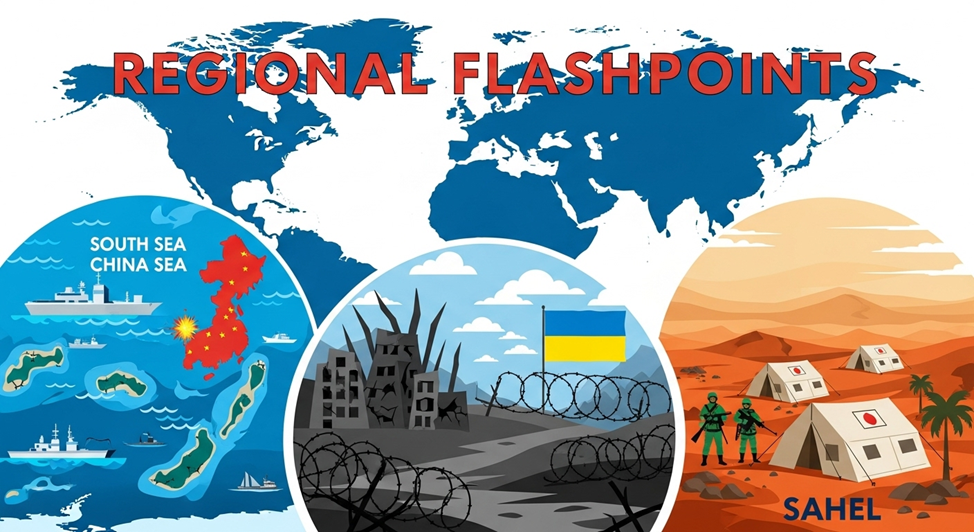
In a world where there is growing interconnection, the conflicts that are based in a region do not stay localized. They cross the boundaries and influence the world politics, economy, and security. Three of these flash points are the South China Sea, Ukraine and the Sahel that exemplifies how difficult modern-day geopolitical rivalries can be. Although the different parts of the world differ in terms of history and participants, they all portray how local conflicts can grow into something of international interest. These flashpoints should be analyzed in order to foresee dangers, develop powerful policies, and address the changing international order.
South China Sea: Maritime dissensions and strategy rivalry.
The South China Sea is a disputed area of maritime space that has existed in the centre of Southeast Asia. It is not merely a geographical location but an economic and strategic route to the world and is a vital sea route that covers about one-third of the global shipping. The claims to the territories and maritime boundary are overlapping in several countries, which are China, Vietnam, the Philippines, Malaysia and Brunei. The gist of the conflict is the sovereignty over the islands, reefs and waters which contain huge deposits of fisheries and possibly rewarding energy deposits.
The nine-dash line claim that covers a large area of the Chinese territory has increased conflict with the neighbors or external powers such as the United States. The issue of freedom of navigation and stability in the region has become a major issue due to Beijing construction of artificial islands and militarization of features in the disputed regions. The U.S. and allies have responded by intensifying naval patrols and freedom-of-navigation operations to prove their claims against China. This has transformed the South China Sea to become a centre of massive power politics whereby the states in the region are torn between maintaining their rights on the one hand and steering clear of an argument with a rising China on the other hand.
In addition to military factors, the case also puts to the test the strength of international law. The case of the 2016 decision of the Permanent Court of Arbitration to invalidate most of the claims by China has not been put into practice, which shows the weakness of the use of legal tools in the face of power politics. South China Sea is therefore not just a maritime dispute, but it sums up the larger battle of rules, norms and power balance in the Indo-Pacific.
Ukraine: War at the Europe Door.
The Ukrainian war is the greatest conflict in Europe after the Second World War and has changed the security design on the continent. The causes of the crisis can be found in the complicated history of Ukraine and Russia and its slow shift towards western institutions, including NATO and the European Union. Annexation of Crimea in 2014 was the start of a new stage of confrontation, however, the full-fledged invasion in February 2022 transformed the crisis into a long-lasting and ruinous war.
It is not only a conflict of control of territory but also competing visions of order in Europe. To Moscow, the Western orientation of Ukraine is an assault on its zone of influence and poses a security threat to its perceptions. To Kyiv and its Western allies, it is a question of defending the sovereignty, democracy, and the European order after the Cold War against Russian aggression. The war has generated a series of events: the soaring of Western sanctions on Russia, the unprecedented growth of NATO and its unity, and the energy crisis that spread all over the world.
The battlefield has turned into an attrition battle with great human and material expenditures. But its meaning is more than Europe. The disrupted exports of Ukrainian fertilizers and food are affecting the food security of countries in the Global South, and the process of geopolitical polarization between the West and Russia, supported by different powers to different extents, has become more pronounced. The war in Ukraine has turned into a test of the quality of international norms in terms of their effectiveness in de-territorial aggression and the capacity of the multilateral institutions in the context of responding to a mass crisis.
The Sahel: Weak States and Diminishing Insecurity.
The Sahel, which is a semi-arid strip running across Africa just below the Sahara desert has become another burning point, although the South China Sea and Ukraine are on the frontline. A convergence of security, governance and humanitarian issues is witnessed in this region, which comprises of Mali, Niger, Burkina Faso and Chad. Out of weak state institutions, endemic lack of development and climatic stress has provided a perfect environment to insurgencies, armed formations and transnational criminal networks.
Over the last ten years, affiliate jihadist organizations under the banners of the al-Qaeda and the Islamic State have multiplied their activities throughout the Sahel, using grievances on the ground and weak border systems. The result of the frequent military coups and political instability has added to the security vacuum. The efforts of the international interventions have not been effective in curbing the wave of violence; these include the operational Barkhane of France and the peacekeeping of the United Nations. Rather, a community backlash against foreign powers has increased and created a new balance of powers and entry of new players like the Russian Wagner Group.
There is a larger stability implication in the Sahel crisis in the region and globally. It contributes to the mass displacement and migration of people to North Africa and Europe, destabilization of adjacent nations and the possibility of achieving a route of uncontrollable areas that can be used as havens of extremist networks. Climate change increases these processes by causing competition to be more intense over limited resources, including water and arable land, turning the Sahel not just into a security issue but also into a benchmark of the comprehensive strategies of development, governance, and peacebuilding.
Overlapping Strands of the Flashpoints.
Even though there is a difference in geography and differences between the South China Sea, Ukraine, and the Sahel, these countries have a number of underlying themes, which can be used to demonstrate the nature of the modern conflicts. To start with, they all reveal the loss of the post-Cold War order and the emergence of multi-polarity, whereby regional powers and non-state actors are questioning the status quo. Second, they emphasize the interaction of local complaints and international conflicts. It may be great power contest in the South China Sea, or ideological and security conflict in Ukraine, or the nexus of terrorism and government in the Sahel, but these hot spots are not islands on their own, but rather a part of the international game.
The other similarity is that there is a weakness of the available multilateral institutions. In both instances, the courts of law, the peacekeeping efforts, or the diplomatic processes have failed to give effective solutions. This highlights the importance of more flexible and inclusive systems that are able to deal with the underlying causes of conflict instead of dealing with symptoms only. Additionally, the three areas emphasize the human aspect of geopolitical crises of displacement, economic disruption, and distrust in institutions. Such expenses are carried more heavily by civilians, which makes it harder to recover and reconcile.
Global Governance/Policy implication.
These flashpoints remain, and that poses crucial questions to policy-makers and analysts. The problem of the South China Sea is that deterrent has to coexist with the dialogue so that it does not escalate accidentally between two great powers. In Ukraine, the balancing act between the need to maintain support to the Kyiv and finding the ways to resolve the situation in the country through some conflicts is a delicate one. In the Sahel, it should stop being military-focused and investing in governance, development, and climate changes to solve the structural causes of insecurity.
In the case of global governance, the examples highlight the need to fill the gap between regional and international approaches. These crises cannot be solved by one actor and still; there is often a fragmentation in coordination. The policy to be developed must go further than mere diplomatic involvement, it must be ready to reform the institutions, to distribute the burdens and to observe the voices of the people affected. The experiences of these areas may also be used to educate a more comprehensive method of conflict reduction and management in the global context.
Conclusion
The South China Sea, Ukraine, and the Sahel are the most eloquent examples of the complexity of the current regional flashpoints. They each present another aspect of the world security environment the great power rivalry that has taken the form of a maritime conflict, the traditional land war that has tested European security, and the diffuse insurgency that has weakened weak states in Africa. But united they demonstrate how in a world of interdependence the lines between regional and global conflicts have been erased. The need to understand these flashpoints is not merely an academic process but a practical one in order to establish a more stable and cooperative international order. The current crises will continue to outline the global politics in years to come unless the appropriate attention and innovative solutions are sustained.